

Why Magnesium Supplementation? + Its Forms and Benefits

Magnesium is an extremely important essential mineral that for a variety of reasons is becoming increasingly difficult to get enough of in our day to day diets. It is needed for more than 300 to 600+ (depending on the study) biochemical and enzymatic processes in the body.
Your bones, heart, brain, everything in your body needs magnesium!

"But", you may ask, "if I'm eating a variety of whole foods, aren't I getting enough from my diet?"
No. Unfortunately there are some major problems with our food supply from monocrop agriculture to ultra-processing that are affecting soil quality, depleting nutrients, and reducing the magnesium levels of your food. Because of this almost half of the US population is deficient in this vital nutrient leading to a number of health issues.

A large part of the problem is the soil used for growing crops, which is becoming increasingly low in essential minerals. For the sake of efficiency, and maintaining our food supply, most modern farms plant the same crop in the same soil over and over and over again. Each time a round of crops is grown they pull nutrients from the soil in order to grow. At harvest they're pulled from the ground and shipped all across our nation, far away from where they were initially planted. Every cycle nutrients get removed from soil and most of the beneficial nutrients and minerals like magnesium slowly deplete over time.
Over many decades the magnesium content in our fruits and vegetables has decreased by at least 30%.

Compounded upon this, the "Standard American Diet" contains very high levels of refined grains and ultra-processed food items. Each step added to the processing of a food item can have drastic effects on its end nutrient content as each step introduces opportunities for nutrient loss and degradation. Some studies estimate that up to 80 or 90 percent of magnesium can be lost by the end of the processing.
Because of these factors almost half of the US population is now deficient in this vital nutrient leading to a numerous number of health issues given magnesium's important role in our bodies. Compounded even further this 50 percent figure for deficiency is based on the Recommended Dietary Allowance (or RDA) as set by our government. Compared to previous generations intake of magnesium, it seems like the RDA might actually be set too low as well because, although societies and lifestyles have changed significantly, our biology as humans is the same as our ancestors were. This indicates, to me at least, that even more people are likely deficient than is currently thought, or at the very minimum, not at the optimal levels they should (or could be) for their overall health goals.

So, now that we know about the problem what are some solutions?
First and foremost we should always aim to eat more nutritionally dense foods, grass fed/finished beef, organ meat, etc. Grass fed is important because if the cows grain feed has had all its magnesium processed out, they, in principle, won't have nearly as much as they could in their meat. One 8oz serving of grass fed beef can contain roughly 50 mg of magnesium.
However, and as important as getting good health food is, getting up to that 600 mg goal is tough from food alone due to the previous factors discussed. Luckily this is where supplementation can help out. If we can't get enough from our diets at least we can take some ourselves.
Upon a quick search for magnesium supplements you'll be quick to see a number of options and forms available, both standalone, and in many common multi-vitamins. But what version should we take? Let's first take a look at the most common version added to fortified foods and many store brand multivitamins:
Magnesium Oxide
The primary benefit of magnesium oxide is its high amount of magnesium per gram. At its most simple, Magnesium Oxide is just oxidized or "rusted" magnesium, making more or less pure elemental magnesium (at least 60 percent by weight). Now initially this seems great, the more magnesium per tablet or capsule the more you get per serving, right? Unfortunately for us it's less than optimal.
Firstly it isn't water soluble, meaning it doesn't distribute well in our guts. The amount that can absorb is also done quite slowly as it lacks the specialized transport carriers other forms can take advantage of to be pulled efficiently from our stomach and intestines. The large unabsorbed portions that is left behind in our intestines also pulls in water as it travels which can cause a strong laxative effect if too much is taken at once. This in turn can cause a loss in ability for it and other nutrients that get caught along for the ride.
All in all only 4-15 percent can be absorbed by the time it makes it through the digestion process. So although it's cheap and readily available just about everywhere is not an ideal choice for supplementation if you want your levels to increase by any significant degree.
Luckily for us there are some other common and moderately inexpensive forms that can help like:
Magnesium Glycinate
Magnesium glycinate is a popular form of magnesium that is made by bonding the element magnesium with the amino acid glycine making it one of the best absorbed forms of magnesium. To start, and unlike the oxide form, it is quite water soluble. This means it's able to dissolve and spread out very efficiently in our gut. Plus our body, upon seeing the glycine bond, is able to treat it like a protein giving it the ability to ride through a number of alternate transport routes. This lets it go straight to work supporting many aspects of our health all while removing the laxative effect other forms of magnesium suffer from.
Plus being bonded to glycine gives it some other unique benefits alongside the standalone benefits of magnesium itself. Two of its major benefits include:
Promoting Relaxation and Sleep
Magnesium helps by aiding the function of neurotransmitters involved in feelings
of relaxation and maintaining a happy and optimistic mood. One of these is GABA, a neurotransmitter that helps to slow down our nervous system activity and calms racing thoughts. Magnesium also blocks the NMDA (N-methyl-D-aspartate) receptor, a receptor in the brain that’s linked to agitation and stress sensitivity. The glycine itself, that the magnesium is bonded to, also assists by lowering our core body temperature in the evening and can help to promote deeper sleep.
Brain Health
Magnesium has multiple roles in the brain. It helps not just with relaxation, but also its function and protection. It does this primarily by supporting synaptic connections, acting as both an essential gatekeeper and as a structural regulator of those connections. This allows it to help improve learning, our working memory, and overall cognitive health. On top of this, adequate levels in our bodies allow it to help fight neuroinflammation and oxidative stress, which is linked to both the aging of the brain and to cognitive decline. Lack of sleep can also be a major player in brain health making its sleep benefits compound here as well.

Magnesium Citrate
Another popular form of magnesium is Magnesium Citrate. It is an organic salt that is made by combining positive magnesium ions and negative citrate ions (from citric acid). Like magnesium glycinate, magnesium citrate is dissolved readily in water and is much easier for the body to absorb compared to forms like magnesium oxide. Due to this increase in solubility and its ionic bonds, it's able to be taken up by cells passively via paracellular diffusion (the passive movement of magnesium ions through the spaces between cells, rather than directly through the tough to penetrate cell membranes) and actively via the TRPM6 and TRPM7 ion channels which allow it be shuttled into cells directly. Also like magnesium glycinate it has a few benefits unique to its citrate form. Aside from it's high absorption a couple of these benefits include:
Kidney Stone Prevention
The citrate component of the magnesium helps by inhibiting the crystallization of calcium oxalate, which is one of the primary causes of oxalate type kidney stones. In theory this effect may potentially help in lowering the risk of these specific stones.
Preventing Muscle Soreness and Cramping
Aside from being an essential mineral, Magnesium, in all its high quality forms, is also a vital electrolyte that alongside potassium and sodium help in controlling our fluid balance, nerve signaling, and muscular relaxation. Because of magnesium citrates ability to cross directly into muscle cells via ion channels it's an ideal candidate for a healthy electrolyte balance.
Preventing Occasional Constipation Magnesium citrate, when taken at higher doses than our body can absorb, acts as an osmotic laxative (it can draw water from the intestines) which can help to soften stool and stimulate a bowel movement for those with difficulty going. Because of this effect it's good to start supplementation slowly once a day and only increase based on your body's needs and reactions. Taking it with full meals can also mitigate this effect in those who want the extra magnesium but do not need this extra bathroom support.
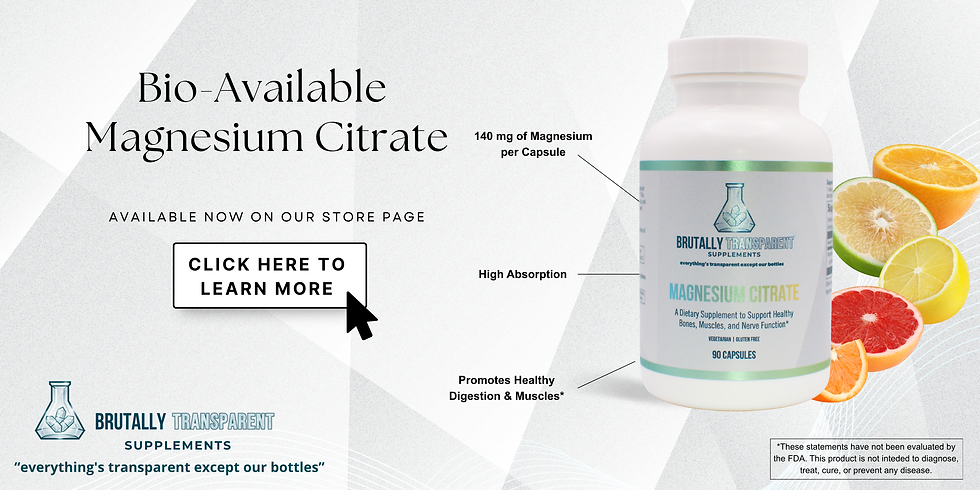
All in all Magnesium, when taken in a bioavailable form, may help to support countless areas our body needs to feel and function at its best. With the declining soil health and processed foods, having an assurance you're getting the essential magnesium you need is paramount. By having absorbable magnesium available in two high quality forms we hope to be able to make getting your daily magnesium a more simple task.
If you found this article helpful or educational in any way, or if you're interested in trying a form of Magnesium that covers the areas explained above (and more!), feel free to check out our Magnesium Glycinate or Magnesium Citrate offerings by clicking their product cards above. And, as always, I thank you for reading and hope you have a fantastic rest of your day!
"Magnesium in Man: Implications for Health and Disease"
"Magnesium: Biochemistry, Nutrition, Detection, and Social Impact of Diseases Linked to Its Deficiency"
"Perspective: The Case for an Evidence-Based Reference Interval for Serum Magnesium: The Time Has Come"
"An Alarming Decline in the Nutritional Quality of Foods: The Biggest Challenge for Future Generations’ Health"
"Going to the roots of reduced magnesium dietary intake: A tradeoff between climate changes and sources"
"Magnesium bioavailability from magnesium citrate and magnesium oxide"
"Voltage-dependent block by Mg2+ of NMDA responses in spinal cord neurones"
"Magnesium and the Brain: A Focus on Neuroinflammation and Neurodegeneration"
"Effects of magnesium supplementation on muscle soreness in different type of physical activities: a systematic review"
"Magnesium: Biochemistry, Nutrition, Detection, and Social Impact of Diseases Linked to Its Deficiency"


Comments